Chicano Park
Location: Barrio Logan
Background Information
Chicano Park originated in 1970 when residents of Barrio Logan learned that land previously promised as a park would instead be used for a California Highway Patrol station. In response, community members occupied the construction site, halted the project, and insisted that the area serve neighborhood needs rather than state policing interests. The park that emerged from this occupation quickly became a focal point for Chicano cultural expression.
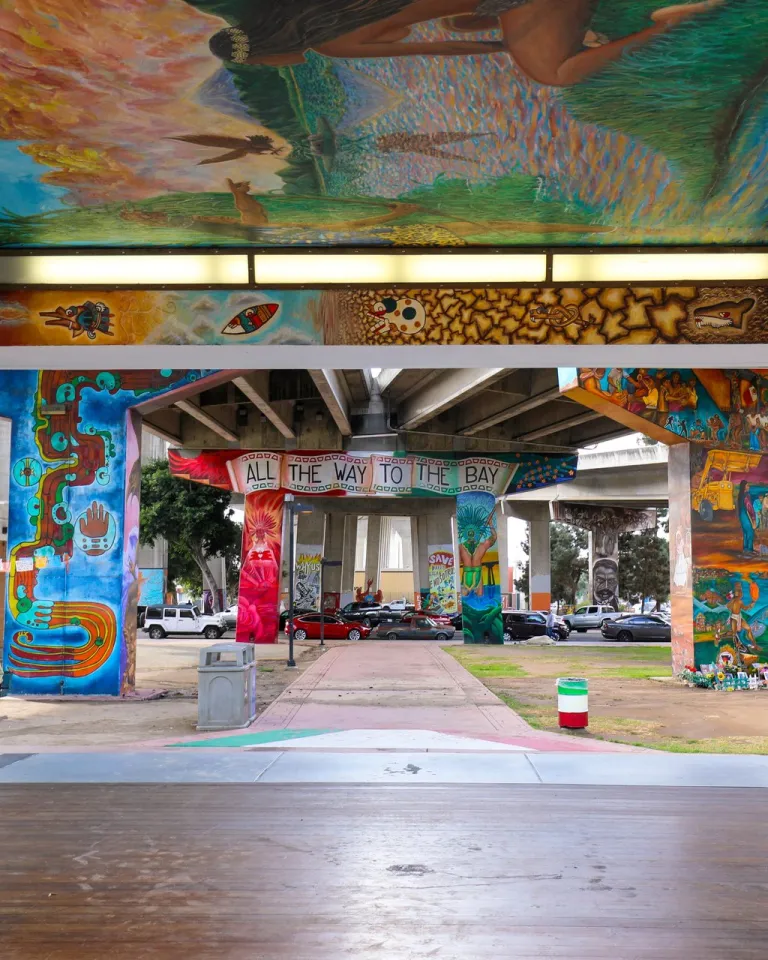
The murals that cover the bridge pylons and surrounding surfaces function as a visual historiography. They depict Indigenous iconography, portray figures from the Chicano Movement, and represent border crossings, labor, and family life. These compositions correct the omissions of dominant curricula by centering narratives that formal institutions have treated as peripheral. The park operates as both a public space and a living archive that documents Chicano political and cultural presence in San Diego.
Rhetorical Analysis
Medium as Message
The decision to paint on the underside of a freeway is itself a rhetorical act. The structure had originally served as a material expression of the city and state redirecting traffic through and over a Mexican American neighborhood. By transforming the bridge supports into canvases, artists repurpose infrastructure that once signified displacement into a monument to continuity and resistance. In McLuhan's terms, the medium, concrete pillars in public space, reshapes the social environment by forcing observers to confront the histories inscribed onto everyday structures.
Circulation and Audience
The circulation of Chicano Park's murals is both local and global. Community members encounter them during daily routines such as walking to school, attending cultural events, and participating in political gatherings. The park is also part of educational tours and heritage tourism, which extends its audience beyond the immediate neighborhood. Globally, photographs and videos circulate across social media platforms, allowing the murals to function as visual shorthand for Chicano resistance.
Resistance and Vulnerability
The park's creation required direct confrontation with state authorities, and its ongoing preservation relies on community organizing and fundraising. The murals are subject to weathering, vandalism, and the shifting priorities of municipal governance. These vulnerabilities reveal the uneven distribution of cultural support and infrastructure and highlight the fragility of marginalized communities' access to public space.